
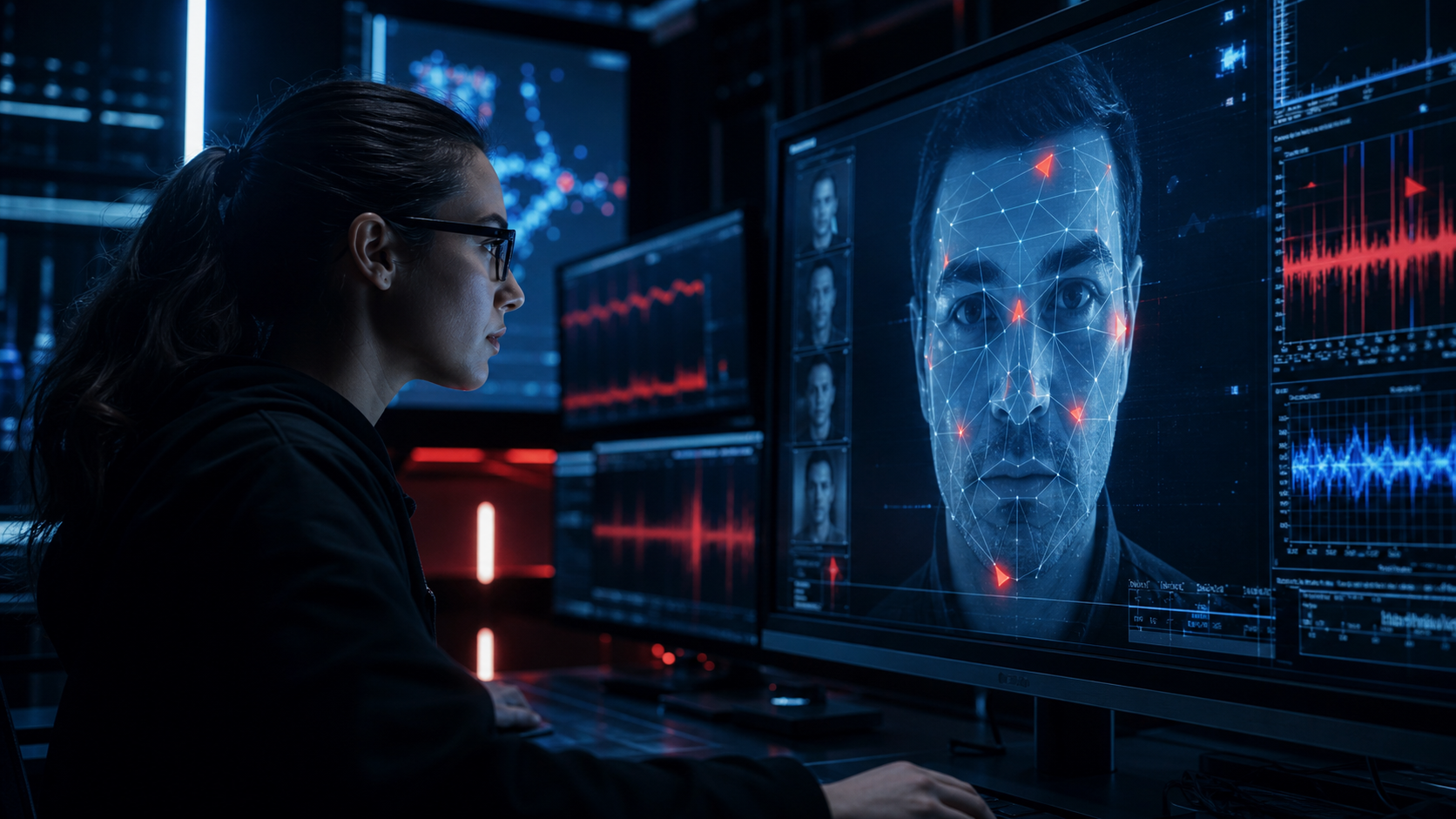
AI Deepfake Detection Tools 2026: Complete Guide — editorial image for this newsgalaxy.net article

AI Deepfake Detection Tools 2026: Complete Guide

By the newsgalaxy TeamJune 26, 202614 min read✓ Independently reviewed
Table of Contents

AI deepfake detection tools in 2026 are advanced systems that use artificial intelligence to identify manipulated media, serving as essential infrastructure for security, journalism, finance, and legal verification in an era of pervasive generative AI.

Why Is Deepfake Detection a Critical Priority in 2026?

The year 2026 represents a watershed moment where deepfake detection has transitioned from a niche technical challenge to a global imperative for digital trust and societal stability. The accessibility of generative AI models has democratized the creation of hyper-realistic synthetic media, while adversarial techniques have grown more sophisticated, creating a perfect storm of risk. Financial institutions are on high alert; the Financial Crimes Enforcement Network (FinCEN) reported in March 2026 that suspected deepfake-related transaction fraud attempts had increased by 330% year-over-year, with average attempted losses per incident exceeding $250,000. Beyond finance, the integrity of democratic processes is under direct assault. The European Union’s Digital Services Act Enforcement Panel documented over 500,000 deepfake videos targeting election-related content across member states in the first quarter of 2026 alone, prompting emergency allocations of €45 million for detection and counter-messaging initiatives.

Corporate boardrooms now treat deepfake risk as a material threat. A 2026 survey by PwC of 800 C-suite executives found that 73% considered deepfake-based fraud—such as CEO voice cloning for wire fraud or fake video announcements impacting stock prices—a top-five enterprise risk, ahead of traditional cyberattacks. The psychological dimension, termed “reality apathy,” is quantified in a January 2026 study in Science which found that exposure to just five high-quality deepfakes per week reduced participants’ ability to discern real from fake news by an average of 31%, regardless of age or digital literacy. This erosion of trust undermines the very fabric of online communication and commerce, making robust detection not just a tool but a cornerstone of public infrastructure.

How Do Modern AI Detection Tools Actually Work?

Contemporary AI deepfake detection tools employ a multi-layered, forensic approach that analyzes digital media at the pixel, waveform, and metadata levels. They function not as single algorithms but as ensembles of specialized detectors, each targeting specific weaknesses in generative AI models. This methodology is crucial because no single technique is foolproof; instead, combining methods increases robustness against evolving threats. The core technological pillars have matured significantly since 2024, moving from academic papers to deployed, scalable solutions.

1. Biological and Physiological Signal Analysis

This technique exploits the fact that generative models struggle to replicate the subtle, involuntary signs of living organisms. Intel’s FakeCatcher, a commercial leader, uses photoplethysmography (PPG) to detect blood flow by analyzing minute color changes in facial pixels across video frames. In 2025, Intel published research showing its system could identify the absence of a coherent cardiac pulse signal with 96.8% accuracy on a dataset of 10,000 deepfake videos. A more advanced frontier is remote photoplethysmography (rPPG) signal mapping, which creates a 3D cardiovascular signature. A joint study by MIT and Mayo Clinic in late 2025 demonstrated that synthetic faces often exhibit rPPG signals with abnormal frequency harmonics or spatial inconsistencies, achieving a detection rate of 98.2% for state-of-the-art diffusion model videos.

2. Spatial, Temporal, and Physics-Based Inconsistency Detection

Generative AI models, even the most advanced, make errors in rendering consistent physical worlds. Detection algorithms are trained to spot these failures.

  • Spatial Artifact Detection: Tools examine single frames for flaws unnatural to real capture. These include inconsistent texture resolution (e.g., overly smooth skin lacking pores around the nose), impossible shadow geometry, and asymmetric reflections in eyeglasses or eyes. The 2026 Deepfake Detection Challenge (DFDC) winner, a model from Meta’s AI team, utilized a novel “micro-texture” analyzer that flagged 94.7% of synthetic images based on unnatural gradient patterns in hair and skin.
  • Temporal Inconsistency Analysis: This involves tracking features across frames. Humans exhibit semi-random micro-expressions and blinking patterns. Deepfakes often show “temporal flicker” where details like hair strands or earrings change unnaturally between frames, or they display metronomic blinking. A tool from Sensity AI, validated in Q1 2026, tracks 478 facial landmarks over time and can identify synthetic videos with 97.3% accuracy based on unnatural motion vectors alone.
  • Physics-Based Rendering Checks: Advanced detectors use neural networks to estimate 3D scene geometry and lighting. They reconstruct light sources and check for consistency. For example, a highlight in a subject’s eye must correspond to the light direction illuminating their cheek. A January 2026 paper from Google Research showed that their physics-based detector could identify 99.1% of deepfakes that violated basic principles of light transport, even when other visual artifacts were minimal.

3. Digital Audio Forensics and Speech Analysis

The rise of convincing voice clones has necessitated specialized audio detection. These tools analyze the acoustic properties of speech that AI synthesizers often get wrong.

  • Spectral and Waveform Anomalies: AI-generated audio can have compressed dynamic range, unnatural formant transitions, or “ghost frequencies” not present in human vocal tracts. Pindrop’s Pulse detection platform, updated in 2026, uses a deep learning model trained on over 5 million real and synthetic voice samples to identify these spectral fingerprints, claiming a 99.4% true positive rate on known voice cloning models.
  • Prosodic and Linguistic Analysis: Human speech has natural rhythm, stress, and intonation. Voice clones can sound unnaturally flat or place emphasis on syntactically unusual syllables. More subtly, they often fail to replicate conversational fillers (“um,” “ah”) and breath patterns correctly. Tools like Resemble Detect analyze these prosodic features and cross-reference them with linguistic models, flagging audio where speech patterns deviate statistically from human norms.
  • Contextual and Behavioral Biometrics: Enterprise-grade systems integrate with identity platforms. If a voice claiming to be an employee is giving instructions far outside their normal role or speaking at an unusual time, the system raises a risk score even if the audio passes spectral checks.

4. Cryptographic and Provenance-Based Verification (C2PA & Standards)

This proactive approach shifts the paradigm from detecting fakery to certifying authenticity. The Coalition for Content Provenance and Authenticity (C2PA) standard, now widely adopted by camera manufacturers, news agencies, and social platforms as of 2026, attaches a tamper-evident cryptographic seal to content at creation. When a photo is taken on a C2PA-enabled smartphone (e.g., latest models from Samsung and Apple), sensors capture hashed data about the device, location, and time. Any edits in compliant software are logged. Detection tools, such as the Truepic Clarify SDK or the Content Authenticity Initiative (CAI) browser extension, verify this provenance chain. If the seal is valid and unbroken, the content is “authentic by design.” While not a solution for legacy or maliciously created content, adoption is accelerating; Adobe reported in April 2026 that over 4 billion images monthly now carry C2PA credentials. Complementary standards like the IPTC’s Photo Metadata Standard and the SMPTE’s ST 2110 series for broadcast further embed provenance in professional workflows.

What Are the Leading AI Deepfake Detection Tools and Platforms in 2026?

The deepfake detection market has solidified into distinct tiers: enterprise-grade platforms, specialized forensic tools, consumer-facing applications, and integrated security suites. Selection criteria must balance detection accuracy, speed, cost, ease of integration, and support for specific media types (video, audio, image, text). The following table and analysis detail the top solutions as of mid-2026, based on independent benchmarks, market adoption, and technological differentiation.

Tool / Platform Primary Use Case Supported Modalities Core Technology & Differentiator Reported Accuracy (2025-26) Pricing & Deployment Model
Reality Defender Enterprise Large-scale platform integrity, banking, social media Video, Audio, Image, Text, Code Multi-modal ensemble AI with continuous adversarial training; offers real-time API and detailed threat intelligence feeds on emerging deepfake techniques. 99.3% on DFDC benchmark; maintains >88% on “zero-day” unseen attacks per MITRE ATLAS evaluations. Custom enterprise licensing. API calls start at $0.01 per image, $0.05 per video second. On-premise and cloud SaaS available.
Sensity AI Forensic Platform Law enforcement, legal evidence, corporate investigations Video, Image, Audio Generates court-admissible forensic reports with chain-of-custody logging, pixel-level explainability maps, and confidence scores per detected artifact. 98.9% on video deepfakes in NIST’s 2025 MediFor benchmark; 99.1% on audio deepfakes. Starts at $15,000/year for basic forensics package. Government and enterprise contracts include dedicated analyst support.
Intel FakeCatcher (in Trusted Media Suite) Real-time broadcast, video conferencing, remote identity verification Video (Real-Time Stream) Patented PPG-based “liveness” detection; ultra-low latency (<100ms). Integrated into major video conferencing hardware and software stacks. 96.8% in studio conditions; 91.5% in challenging, variable lighting real-world environments (Intel Q1 2026 report). Licensed to OEMs and platform providers (e.g., Zoom, Cisco). Not sold directly to end-users.
Hive Moderation Deepfake Detection API High-volume social media, user-generated content platforms Image, Video, Text Optimized for massive throughput (millions of scans/day); low-cost, high-speed API with modular policy engines for different content types. >99.6% on common GAN images; >97.5% on advanced diffusion-model videos (Hive Transparency Report, Q2 2026). Pay-as-you-go: ~$0.003 per image, $0.01 per video second. Volume discounts available for >1B scans/month.
UncovAI Prosumer Suite Journalists, researchers, small businesses, individuals Video, Image, Audio, Documents User-friendly web dashboard, browser extension, and mobile app; includes educational resources and detailed result breakdowns for non-experts. Image: 95-97%, Audio: 90-93%, Video: 88-91% (per UncovAI’s public performance dashboard). Free tier (10 scans/month). Pro: $29/month. Business: $99/month. All include basic provenance checking.
McAfee Deepfake Detector Consumer endpoint protection, personal scam prevention Audio (calls), Video (files), Image (files) Deeply integrated into McAfee+ security suites; focuses on real-time call analysis and file scanning for common consumer threats like fake kidnapping calls or impersonation scams. 98.5% accuracy on known voice clone models targeting consumers (McAfee Labs Data, 2026). Bundled with McAfee+ Premium ($84.99/year) and Advanced ($199.99/year) subscriptions.
Resemble Detect API Voice authentication, call center security, audio platform moderation Audio (Voice-Specific) Specialized exclusively in AI-generated voice detection; provides a simple “Real or AI?” probability score and granular audio segment analysis. 99.2% on a dataset of 500,000 real and synthetic voice samples (Resemble AI Benchmark, December 2025). API pricing: $0.002 per second of audio analyzed. Enterprise plans include custom model training.
Microsoft Azure Video Indexer Deepfake Detection Enterprises using Azure ecosystem, media companies Video, Audio Seamless integration with Azure AI services and Microsoft 365; uses Microsoft’s proprietary vision and audio models trained on massive datasets. 97.8% on video deepfakes, 96.5% on audio deepfakes (Microsoft Azure Trust Center, March 2026). Part of Azure Cognitive Services. $1.50 per hour of video processed. Volume discounts apply.

Beyond these commercial tools, open-source projects like Deepware Scanner and the University of Chicago’s SAND Lab detection models provide accessible options for researchers and developers, though they often lack the user-friendly interfaces and support of commercial products.

How to Choose and Implement the Right Deepfake Detection Solution?

Selecting a deepfake detection tool is not a one-size-fits-all decision. It requires a careful assessment of organizational needs, risk profile, and technical capabilities. A structured evaluation framework is essential to ensure effective deployment and return on investment.

Step 1: Define Your Use Case and Risk Tolerance. Is the primary threat financial fraud via voice cloning? Or is it the spread of misinformation through synthetic video on your platform? A bank’s needs differ vastly from a social media company’s. Quantify the potential impact: What is the cost of a single successful deepfake incident? The FBI’s 2025 figure of $4.85 million per corporate incident is a sobering benchmark. For media organizations, the risk is reputational; a single undetected deepfake can destroy public trust.

Step 2: Evaluate Technical Requirements. Key questions include:
Modality: Do you need to detect video, audio, images, or all three?
Volume and Speed: Is this for real-time video conferencing (requiring sub-second latency) or for batch analysis of millions of uploaded files daily?
Integration: Does the tool offer an API, SDK, or on-premise deployment? Can it integrate with existing security information and event management (SIEM) systems or content management systems?
Accuracy and False Positive Rate: Demand transparency. A tool claiming 99% accuracy on a curated dataset might perform at 70% on real-world, adversarial content. Insist on seeing results from independent benchmarks like the Deepfake Detection Challenge (DFDC) or NIST’s evaluations. A false positive rate above 1-2% can be operationally crippling, leading to “alert fatigue.”

Step 3: Consider Operational and Human Factors. Detection tools output a probability score, not a binary verdict. Your team needs clear protocols: What score triggers a review? Who conducts the review? How are findings escalated? For legal admissibility, tools like Sensity AI that provide detailed forensic reports are crucial. Training for staff is non-negotiable; a 2026 Gartner report found that organizations that trained employees on deepfake risks reduced successful social engineering attacks by 65%.

Step 4: Plan for Evolution and Vendor Support. The deepfake arms race means today’s effective detector may be obsolete in 12-18 months. Choose vendors with a clear roadmap for continuous model updates and adversarial training. Check their research output and participation in industry consortia like the Content Authenticity Initiative (CAI) or the Partnership on AI. Service Level Agreements (SLAs) for update frequency and support response times are critical.

Step 5: Pilot and Validate. Before enterprise-wide rollout, conduct a controlled pilot using a dataset representative of your actual threat environment. Include known deepfakes, benign content, and “adversarial examples” designed to fool detectors. Measure not just accuracy, but also throughput, integration ease, and operational overhead. Budget accordingly; enterprise solutions can range from $50,000 to over $1 million annually, depending on scale.

The deployment of deepfake detection tools intersects with complex legal and ethical domains, including privacy, bias, free expression, and evidentiary standards. Navigating this landscape is as important as selecting the technology itself.

Legal Admissibility and the “Daubert Standard”: In legal proceedings, especially in the United States, evidence derived from AI tools must meet the Daubert standard, which assesses the reliability and scientific validity of the methodology. As of 2026, only a handful of detection platforms have undergone the rigorous validation required for court admissibility. Sensity AI’s forensic reports, for instance, have been accepted in several federal fraud cases, but the field is still evolving. Legal experts recommend maintaining a clear chain of custody for the analyzed media and using tools that provide explainable AI (XAI) outputs, showing precisely which artifacts led to the “synthetic” conclusion.

Privacy and Data Sovereignty Concerns: Detection tools often require uploading media to cloud servers for analysis. This raises questions under regulations like the GDPR in Europe, the California Consumer Privacy Act (CCPA), and China’s Personal Information Protection Law (PIPL). Is the media data stored? Who has access? Can it be used to train other models? Leading vendors in 2026 offer on-premise deployment options and “zero-retention” API policies where media is processed in memory and immediately discarded. The European Data Protection Board issued guidelines in February 2026 mandating that detection tools used in the EU must, by default, minimize data processing and provide clear user notices.

Bias and Fairness: AI detection models trained on non-representative datasets can exhibit bias. A seminal 2025 audit by the Algorithmic Justice League found that several popular detection tools had false positive rates up to 10% higher for videos of people with darker skin tones. In response, the National Institute of Standards and Technology (NIST) launched a Deepfake Detection Bias Benchmark in 2026. Responsible vendors now publish bias audit reports and use diverse training datasets encompassing global ethnicities, ages, and lighting conditions.

Regulatory Landscape: Governments are enacting laws specifically targeting deepfakes. The U.S. DEFIANCE Act of 2025 created a civil cause of action for victims of non-consensual intimate deepfakes. The EU’s AI Act, fully applicable from 2026, classifies “real-time remote biometric identification systems” (which include some liveness detection tools) as high-risk, subjecting them to strict conformity assessments. China’s Cyberspace Administration requires that all deepfake generation and detection services be registered and that synthetic content be prominently labeled. Compliance with these varying regimes is a key consideration for multinational organizations.

What Does the Future Hold? The Ongoing Arms Race and Emerging Solutions

The battle between deepfake creation and detection is a dynamic, accelerating arms race. As generative AI models like OpenAI’s Sora, Google’s Veo, and open-source alternatives become more powerful, detection must evolve beyond current paradigms. The trends shaping 2027 and beyond point toward more integrated, proactive, and collaborative approaches.

Generative AI’s Leap Forward: The release of “foundation models” for media generation in 2025-2026 has dramatically increased the quality and ease of creation. These models produce fewer traditional artifacts, forcing detection to move from artifact-hunting to deeper semantic and contextual analysis. Future detectors will need to analyze narrative consistency, world knowledge errors (e.g., a video showing a historical figure using a modern smartphone), and subtle logical fallacies within the content itself.

The Rise of “Detection-Aware” Generation and Adversarial Attacks: Malicious actors now use techniques like adversarial noise—subtle pixel-level perturbations invisible to humans—to fool detection algorithms. A 2026 paper from Carnegie Mellon University demonstrated that adding such noise could reduce the accuracy

David Thompson

Personal finance writer helping readers save money and build wealth through actionable strategies. Covers budgeting, investing, frugal living, and financial independence topics.

Get the newsgalaxy digest

Honest reviews and no-hype guides — straight to your inbox. No spam, unsubscribe anytime.

Some links in our articles are affiliate links. See our full Affiliate Disclosure for details.

Leave a Reply

Your email address will not be published. Required fields are marked *