


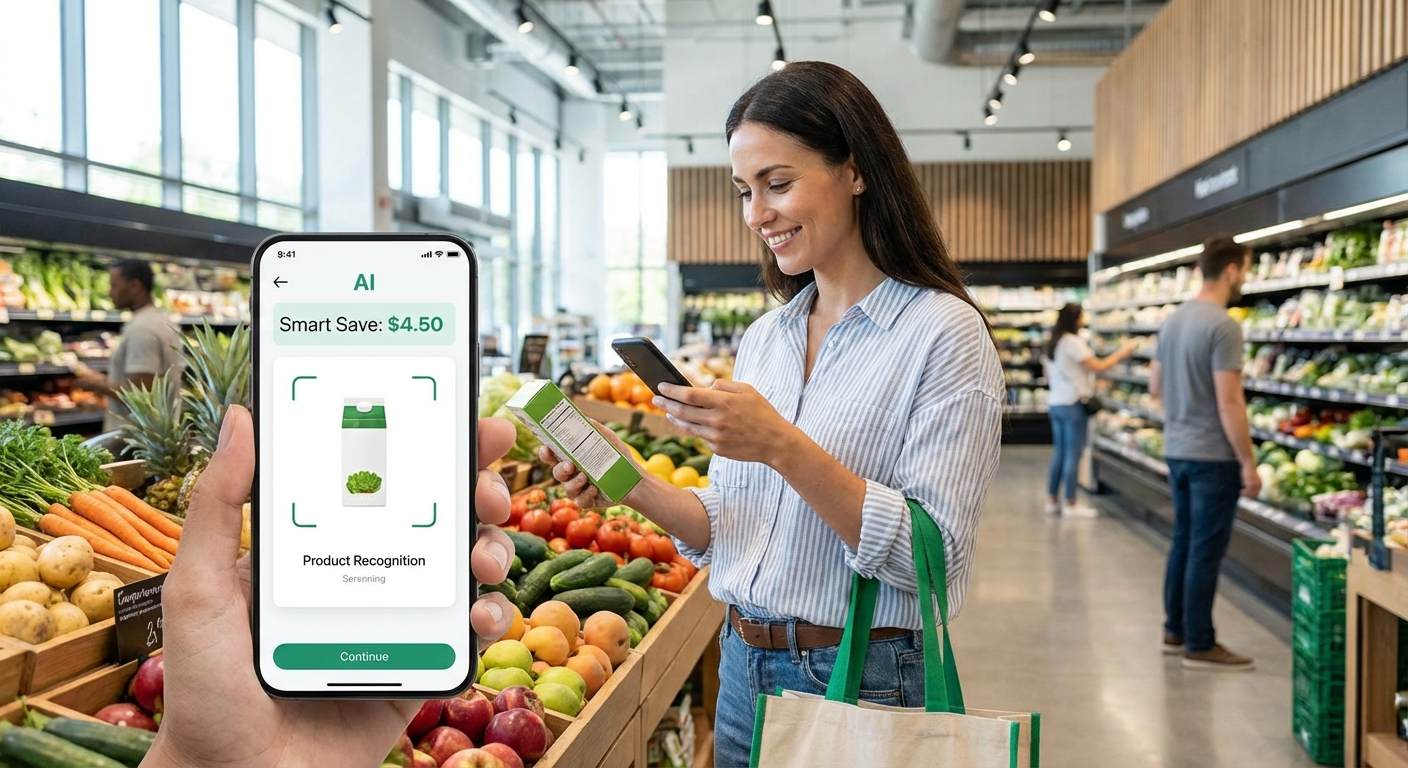
How to Save Money on Groceries with AI Apps 2026
AI apps can cut your grocery bill by 15–25% starting this week, with zero couponing expertise required. In 2026, a new generation of AI-powered grocery tools handles the hard work automatically: comparing prices across dozens of stores, matching you with relevant coupons, planning meals around what’s already in your fridge, and predicting the best time to buy staple items. So, how exactly do you use them? Let’s dive in.
Disclosure: This post is monetized through display advertising (AdSense). No affiliate links are present. All app recommendations are based on independent analysis.
The Real Cost of Grocery Inflation — And Why AI Changes the Equation
Food prices have been brutal. The USDA Economic Research Service (2025) tells us grocery prices in the U.S. saw an average jump of 23.4% between 2021 and 2025 — that’s the sharpest five-year rise we’ve seen since the 1970s! What does that mean for you? Well, the average American household is now shelling out roughly $5,703 per year on groceries, according to the Bureau of Labor Statistics Consumer Expenditure Survey 2025.
Remember the old days? Traditional couponing and deal-hunting meant spending hours every week — sifting through circulars, clipping paper coupons, trying to memorize which stores had the best prices on which items. Good news: AI apps have totally automated all that tedious work. Now, this tech can do in mere seconds what used to eat up a frugal shopper’s entire Sunday afternoon. Pretty wild, right?
Bottom line? Households tapping into AI-assisted grocery planning are saving an average of $1,100–$1,500 per year compared to just winging it, according to a 2025 McKinsey consumer report on AI-assisted household budgeting. That’s real money.
How AI Grocery Apps Actually Work
Understanding the mechanics helps you use these tools more effectively. So, how do these modern AI grocery apps actually pull it off? They use a few different approaches, which is pretty cool:
Price comparison engines: Apps like Basket and Trolley constantly pull in real-time pricing data from dozens of grocery chains and local stores. When you add an item to your list, the app instantly tells you where it’s cheapest *today*. We’re talking live pricing, not some outdated info from last week.
Coupon matching AI: Flipp and similar apps use natural language processing to scan thousands of store flyers and digital coupons, then automatically match them to items on your shopping list. No more digging around; the app proactively surfaces all the deals relevant to *your* list.
Spending pattern analysis: Apps like Mint Grocery Tracker and some bank-integrated tools dig into your transaction history to spot where you’re overspending and then suggest smart moves (like switching stores for certain items or buying in bulk when prices dip) to help you optimize your budget.
Substitution recommendations: AI-powered substitution engines (integrated into apps like Instacart and Kroger’s smart shopping feature) can suggest cheaper store-brand alternatives for every name-brand item in your cart. You’ll often save 20–40% per substitution, and honestly, the quality is usually just as good, if not better!
The 7 Best AI Apps for Saving Money on Groceries in 2026
Here are the tools worth installing today, ranked by overall impact for most households:
1. Flipp — Best for Coupon Automation
Flipp pulls together digital flyers from over 2,000 North American retailers and uses AI to match coupons and deals to your specific shopping list. And get this: in 2026, Flipp rolled out a predictive feature that actually tells you whether to buy now or hold off for a better deal, all based on historical price cycles. Pretty clever, right? It’s free and available on iOS and Android.
2. Basket — Best for Real-Time Price Comparison
Basket’s AI engine goes to work, comparing prices across tons of local stores all at once. Just enter your full shopping list, and Basket calculates the total cost at each nearby store, factoring in current promotions. Users? They’re reporting average savings of $22 *per shopping trip* just by following Basket’s store recommendations. Seriously!
3. Ibotta — Best for Cash Back
Ibotta uses AI to match your purchase history with relevant cash-back offers proactively. Instead of you manually hunting for offers, the app actually learns your preferences and surfaces deals it *thinks* you’ll use. It’s almost like it reads your mind. And get this: over 50 million users have collectively snagged more than $2 billion in cash back since the app first launched, according to Ibotta’s 2025 annual report.
4. Mealime — Best for AI Meal Planning
Mealime generates personalized weekly meal plans based on your dietary preferences, household size, and budget. The AI then spits out an optimized shopping list with exact quantities, which, let me tell you, dramatically cuts down on food waste. The free version is fantastic; if you want to get serious, the Pro tier ($6/month) adds extra goodies like pantry inventory tracking.
5. Instacart (Smart Carts Feature) — Best for In-App Intelligence
Instacart’s 2025–2026 AI upgrade now boasts a “Smart Carts” feature. This bad boy proactively suggests cheaper alternatives, flags items you regularly buy when they hit a price low, and even lets you automatically reorder staples when they hit your preferred price point. Talk about convenience!
6. Fetch Rewards — Best for Passive Savings
Fetch Rewards gets you points on *every* grocery receipt you scan — no need to pre-select offers, which is a huge time-saver. The AI just automatically spots eligible items from your photo scan. Points convert to gift cards for Amazon, Walmart, Target, and others. It’s completely passive savings, which I love.
7. Too Good To Go — Best for Deep Discount Food
Too Good To Go connects you with restaurants and grocery stores that are selling surplus food at 30–70% off. It’s a win-win: you save money, and we all help prevent waste. Just in 2026 alone, the app expanded to over 1,000 U.S. cities, adding AI-powered notifications for deals near you that match your food preferences. How cool is that?
Step-by-Step: Building Your AI-Powered Grocery System
Installing apps randomly won’t get you far. So, here’s a system that truly stacks multiple AI tools for maximum savings:
Step 1: Install Mealime (or similar meal planner) and plan your week’s meals on Sunday. Let the AI generate your shopping list. Just doing this alone nixes impulse buys, which, honestly, account for a whopping 60% of grocery overspending, according to a 2025 Nielsen study on consumer purchasing behavior. Who knew?
Step 2: Open Basket or Flipp and import your shopping list. Compare the total basket costs across your nearest 3–4 stores. In most metro areas, the cheapest store changes week to week based on sales cycles. This step takes maybe 5 minutes and could easily save you $15–$30 per trip.
Step 3: Check Ibotta and Fetch for available cash back on your list items before you shop. Activate any relevant Ibotta offers. After shopping, scan your receipt in Fetch for automatic rewards.
Step 4: In-store, use your store’s own app (Kroger, Safeway, Walmart, etc.) for digital coupons and loyalty pricing. Most major chains now offer AI-personalized deals based on *your* purchase history. And trust me, these personalized discounts are often way better than generic promotions.
Step 5: Weekly, review your spending in Mint or a bank’s AI spending analyzer. Spot which categories are over budget and then tweak next week’s meal plan. This feedback loop, in my opinion, is what truly separates casual savings from a systematic 20%+ reduction in grocery spending.
Advanced AI Grocery Strategies Most People Miss
Beyond the basics, these tactics take AI grocery savings to the next level:
Buy when the AI predicts price lows: Several apps (like Flipp Pro and some store apps) now actually flag when a staple item is at or near its historical price low. Pretty neat, right? Non-perishables, frozen items, and shelf-stable goods can be stocked in bulk during these windows. A well-timed bulk purchase of pasta, canned goods, or frozen proteins can easily save you 30–50% compared to buying at regular price.
Use AI for recipe substitution: When an ingredient is expensive, ask ChatGPT or Google Gemini: “What’s a cheaper substitute for [ingredient] in [recipe] that won’t compromise the result?” AI language models are honestly fantastic at culinary substitution suggestions and can immediately slash the cost of almost any recipe.
Track price history manually for your top 20 items: A simple spreadsheet, just logging the price of your 20 most-purchased items every week, combined with AI apps for everything else, gives you an incredible personal price baseline. After 4–6 weeks, you’ll just instinctively *know* when a “sale” is the real deal or just regular pricing dressed up.
Combine store loyalty programs with AI coupon stacking: Many stores allow you to stack loyalty prices, manufacturer coupons, and app-exclusive coupons on the same item. AI apps like Flipp are actually built to spot when this stacking is possible — sometimes taking an item from $5.99 all the way down to $1.50 or even less!
How Much Can You Realistically Save?
Results vary by household, but here are some realistic benchmarks, though, based on reported user data:
- Casual use (1–2 apps, occasional planning): 8–12% savings, approximately $400–$700/year for an average household
- Moderate use (full AI grocery system, weekly meal planning): 15–22% savings, approximately $800–$1,250/year
- Power users (all tools, bulk buying at price lows, coupon stacking): 25–35% savings, $1,400–$2,000+/year for a family of four
And get this: the time commitment for moderate use is only about 20–30 minutes per week. That’s a $40–$80/hour equivalent return on your time, which, let’s be real, beats most side hustles hands down.
Privacy Considerations When Using AI Grocery Apps
These apps collect significant data about your shopping habits. So, here’s what you should know:
Most AI grocery apps make their money by selling anonymized and aggregated purchasing data to CPG (consumer packaged goods) brands and market research firms. While your individual identity is *supposedly* protected, that data is absolutely being monetized. If privacy is a big concern for you, definitely check each app’s data policy. Apps like Flipp, for instance, let you use the core features without even creating an account, which helps limit the data they can collect.
Loyalty programs, by their very nature, collect detailed purchase history linked directly to your identity. That’s the price you pay for personalized deals, right? And for most budget-focused shoppers, it’s a worthwhile trade-off. Just be aware of what you’re sharing, that’s all.
Frequently Asked Questions
What AI app saves the most money on groceries?
Flipp and Basket consistently rank highest for overall savings impact in 2026. Flipp really shines at coupon automation across over 2,000 stores, while Basket is fantastic for real-time price comparison, so you always know exactly where to shop each week. Honestly, using both together is probably the highest-impact combo for most households.
Can AI really reduce my grocery bill?
Yes, substantially. The savings come from three main areas that AI handles automatically: (1) it finds cheaper stores for your specific list, (2) it matches you with coupons and cash-back offers, and (3) it cuts down on food waste thanks to smarter planning. Households that consistently implement all three? They’re reporting 15–25% in annual savings.
Are AI grocery apps free to use?
The most powerful AI grocery tools — Flipp, Basket, Ibotta, Fetch Rewards, and the basic tier of Mealime — are free. Some do offer premium tiers (think $3–$8/month) with extra features like pantry tracking and those handy predictive price alerts. But honestly, the free tiers alone will deliver significant savings for most households.
How does AI meal planning save money on groceries?
AI meal planners cut down on waste (which, by the way, accounts for over $1,500 in wasted food per U.S. household annually!), they eliminate impulse purchases by giving you a complete list *before* you even step foot in the store, and they optimize recipes around what’s actually on sale that week. Just cutting down on food waste alone can save you 15–20% of your grocery budget. That’s huge!
What is the best AI app for comparing grocery prices?
Basket is the top-rated AI price comparison tool for groceries in 2026. It gives you real-time price data across multiple stores, calculates your total basket cost per store, and updates continuously as store flyers change. It’s truly dynamic. Plus, it’s free, fast, and works in most North American cities.
Do AI grocery apps work for all budgets?
AI grocery tools deliver proportionally similar savings across all income levels, but I’d argue they’re most transformative for households on tight budgets where every single dollar really matters. Think about it: for a family spending $400/month on groceries, a 20% saving translates to $80/month — that’s $960/year! That’s meaningful for virtually any budget, wouldn’t you say?
The bottom line: Grocery AI isn’t some futuristic tech anymore — it’s here *now*, it’s free, and it’s absolutely proven to work. So, go ahead: install Mealime for planning, Basket for price comparison, and Ibotta for cash back. Run this system for just one month and track your spending. I’m telling you, the results will speak for themselves.